

Strategy in action
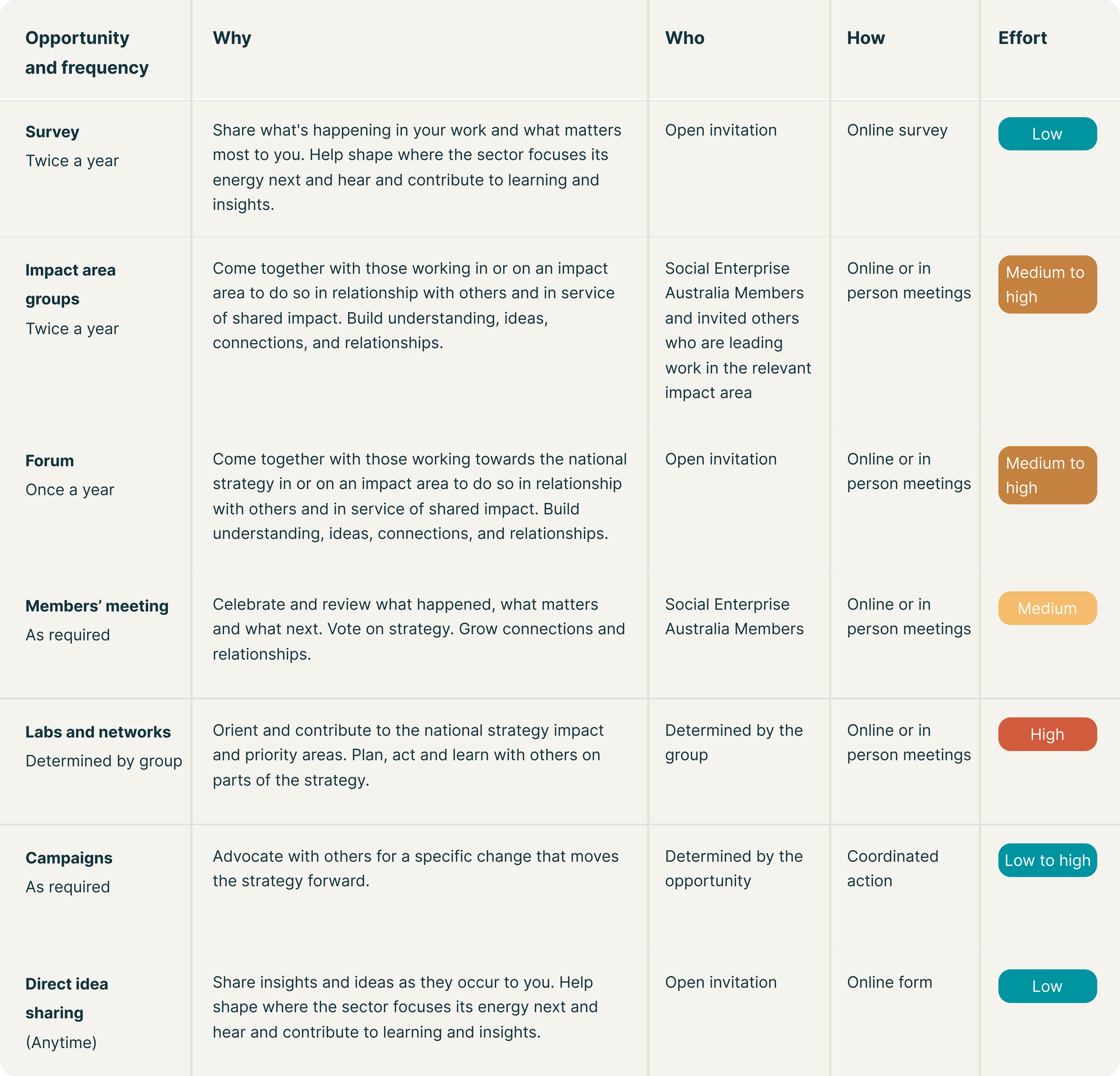
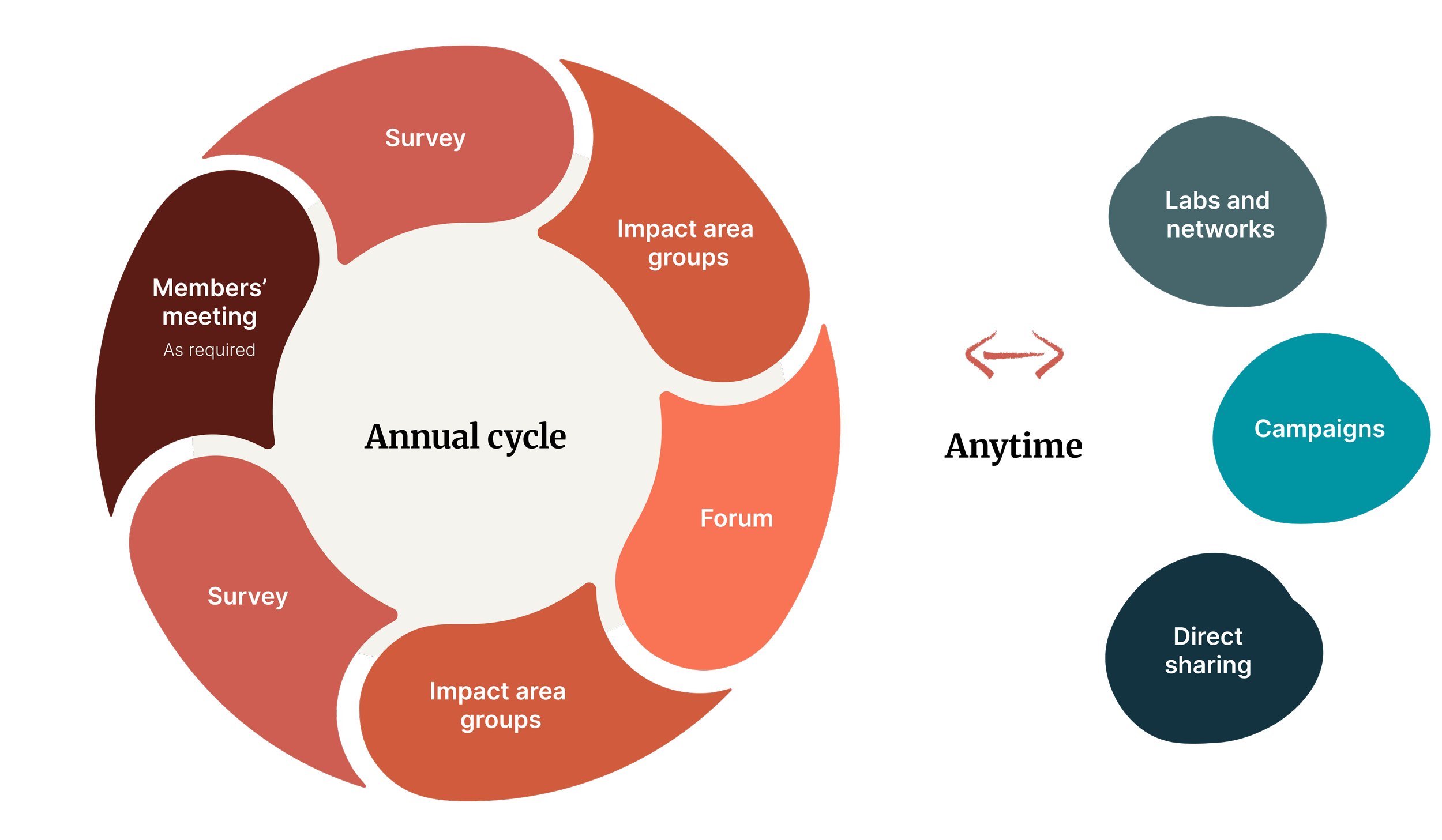
Australia's social enterprise strategy will only work if many and diverse people and organisations drive it. People can contribute in their own ways, and below are coordinated ways to get involved.
Our Members sit at the heart of this work. They co-design and take action on key parts of the strategy. They are invited to all parts of the annual ways to get involved.
Impact areas
This strategy focuses on five areas where social enterprise can drive big impact. Many social enterprises work across more than one.
Social Enterprise Australia convenes a group for each impact area so that people can:
Come together and build relationships with other working in or on an impact area, in service of shared impact.
Build understanding, ideas, connections, and relationships.
The groups are:
-
We are in a time of ecological crisis. Environmental care protects, repairs, regenerates and connects us to the natural systems that all life depends on. It supports healthier people and communities.
Environment-focused social enterprises exist to change what and how we make, distribute and use things, to care for the planet. They are businesses that keep resources in use and care for natural systems across the life of products. They explain why they do this and influence and support others to do the same.
-
Decent work pays fairly, is safe and secure, and offers equal opportunity and treatment. It gives people the chance to grow, have a say and shape their future. Access to decent work means everyone who wants it can choose it.
Jobs-focused social enterprises create jobs and pathways to employment and self-employment for those most shut out of work. They combine real work settings with wrap-around support. In communities with too few jobs, they create new ones. In doing this, they prevent and address long-term unemployment. They also complement universal government-funded employment services and influence and support mainstream employers to be more inclusive.
-
First Nations self-determination means First Nations peoples having the power to make decisions about their lives, communities and futures. It means setting priorities, controlling assets and leading the institutions that shape community care and wellbeing.
First Nations-led enterprises put culture, Country, and community at the heart of their work. They generate income and jobs, and grow community care, wealth and capability. Many also strengthen culture, identity, relationships and community institutions, and contribute to social and political change. In this way, they grow self-determination.
-
Goods and services support people's wellbeing, participation, culture and identity. Access to them means people can get what they need — reliably, affordably, and in ways that fit their lives.
Social enterprises design and deliver goods and services around people's lived realities and community priorities. They respond to unmet needs and improve access by prioritising trust, affordability and quality. They do this in ways that are culturally safe and fit individual or community contexts. They focus on deep listening, prevention and long- term wellbeing, showing what it looks like when goods and services work for the people they serve.
-
People and communities shape their own futures when those affected by decisions make them together. This can only happen when power is shared, and people and communities have what they need to participate and lead.
Social enterprises create practical ways for people and communities to meet their own needs and priorities. They often embed participation, shared ownership, shared benefit, and accountability into how business is done. Many are led by and focused on a community or place. Many ensure lived experience and people shut out by current systems are part of decisions and action. In doing so, they build trust, connection and belonging, including across difference, and show how business can work for the common good.
Priorities
To drive outcomes and impact, we work together on priorities to deliver the strategy. There are a lot of things social enterprises need to realise their potential. These are the priorities the ecosystem decided we needed to get right first.
Across them, work is already happening in different ways — some led by Social Enterprise Australia, some by others in the ecosystem
The priorities are:
CONNECT AND ALIGN
-
This strategy will only work if many and diverse people and organisations drive it, with infrastructure to support it in place. This means ways for people to participate, and platforms and coordination that enable people to plan, act and learn together over time.
Social Enterprise Australia’s coordinated participation opportunities are one expression of collaboration infrastructure for the ecosystem.
There are also others supporting collaboration.
We have social enterprise peak bodies in every state and territory in Australia, that support collaboration in their region.
A wide range of social enterprise networks are listed in the sector directory and map on Understorey - a knowledge commons for social enterprise shaped by all who choose to take part, and coordinated by Social Enterprise Australia. If you’re part of a network you want added to the directory and map, add it here.
Regen Labs’ WEAVE is exploring what it looks like to support regenerative social enterprises in regional Australia to lead the shift toward just, climate-resilient local economies. The framework they developed examines ways to support the ‘weavers of collaboration’ in places.
Ready Communities has launched six national regional challenges focused on drought and tourism, volunteering, housing, telling a shared story, community capital, and interrelation generations. Share your case study of impact by 24 July.
Catalyst Now supports collaborations of changemakers who come together to create solutions to the world’s most pressing challenges.
-
The priorities and actions for First Nations self-determination must be set by First Nations people, not by the broader ecosystem on their behalf. The priority is taking steps for that leadership and roadmap to happen.
In the strategy development process, the sector began to explore Country-centred thinking through the Indigenous Doughnut.
This work is linked to the First Nations self-determination impact area group. Express your interest to join this impact area group.
The Social Enterprise Development Initiative also includes a dedicated First Nations focus that surfaces insights that connect to this work.
-
Many people don't know what the sector is, needs, or how to get involved. This holds it back from being seen, valued, and supported. Changing this will take stories, a clear and compelling narrative about the value of social enterprise, and coordinated advocacy for the customers, capital, policy and investment the sector needs.
Social Enterprise Australia’s advocacy page shares the submissions we’ve made over time, in consultation or co-design with the sector.
BUILD KNOWLEDGE AND PRACTICE
-
Current data on the Australian social enterprise sector is inconsistent, outdated and fragmented or hidden. And some social enterprises don’t yet know that’s what they are. Together, these gaps limit decision-making and support. Building shared infrastructure to better identify social enterprises, and to collect, use and learn from data, is foundational to most of these priorities.
Understorey is a knowledge commons for social enterprise - a place to learn and exchange about social enterprise. It is shaped by all who choose to take part, and coordinated by Social Enterprise Australia.
The National Social Enterprise Research Project has been commissioned by the Australian Department of Social Services to improve social enterprise data infrastructure and public knowledge about these organisations.
Seedkit is a free, self-managed impact reporting and learning tool that can also produce insights about the social enterprise sector. It is owned and hosted by Melbourne Social Equity Institute at the University of Melbourne.
-
Social enterprises need to develop their practice and capability - in impact, business, and how to blend the two. This should build on and share sector experience and expertise, not treat capability as a problem to fix. The priority is shared infrastructure, accessible to all, that supports people to learn from and with each other, and from their own experience.
These are some of the organisations and initiatives providing capability infrastructure for the sector.
Social Enterprise Development Initiative learning communities connect people to learn from practice and share experiences and insights.
Seedkit is a free, self-managed impact reporting and learning tool that can also produce insights about the social enterprise sector. It is owned and hosted by Melbourne Social Equity Institute at the University of Melbourne.
SIMNA are a community of practice that lead and shape the development of social impact measurement in Australia and around the world.
The Centre for Social Purpose Organisations is launching Australia’s first ever national study focused on effective strategic decision-making in not-for-profit organisations. Register your interest to participate in and learn from the research.
A wide range of social enterprise capability builders are listed in the sector directory and map on Understorey - a knowledge commons for social enterprise shaped by all who choose to take part, and coordinated by Social Enterprise Australia. If you’re a capability builder and want to be added to the directory and map, add your organisation here.
-
Social enterprises should not just keep up with digital change, they should help lead it. Technology is not good or bad: what matters is how it is used and what for. The priority is to build the shared capability and capacity to harness digital technology and tackle its potential harms, including digital exclusion, and loss of ownership, privacy or human relationships.
There are already some excellent initiatives working towards this goal.
Infoxchange convene NFP Digital Futures is, an initiative bringing together not-for-profits, peak bodies, philanthropy, government, industry and technology to strengthen digital capability across the sector. They're currently inviting organisations to be part of what comes next. They’re part of the Australian Digital Inclusion Alliance and offer low or no-cost resources on their digital transformation hub.
The Centre for Social Impact is conducting research to identify critical barriers to digital inclusion and how to overcome them.
And Good Things Australia support community organisations across Australia to run digital inclusion programs that make a real difference in people's lives.
If upskilling your organisation on AI is what you need, you might like to try National AI Centre or Microsoft Elevate for Changemakers.
-
This commitment belongs to the whole ecosystem. The priority is for the ecosystem — collectively and individually — to examine and shift its systems, structures and mindsets that marginalise First Nations people. Progress means First Nations leadership and knowledge are shaping how the ecosystem works and what it works towards.
In the strategy development process, the sector began to explore Country-centred thinking through the Indigenous Doughnut.
The Social Enterprise Development Initiative also includes a dedicated First Nations focus that surfaces insights that connect to this work.
CREATE CONDITIONS FOR GROWTH
-
Social enterprises create value and savings for government and communities. They are often not funded for it. For those that bear costs that standard businesses do not - costs to deliver impact - this limits their ability to sustain and scale their impact. The priority is to open up access to funding for these enterprises.
Existing funding opportunities are listed on the funding feed on Understorey a knowledge commons for social enterprise shaped by all who choose to take part, and coordinated by Social Enterprise Australia. A wide range of social enterprise philanthropic organisations are also listed in the sector directory and map on Understorey. If you’re a philanthropic organisation and you want to be added to the directory and map, add your organisation here.
Understanding the Impact Costs of Work Integration Social Enterprises is research by the Centre for Social Impact Swinburne that explores the additional costs jobs-focused social enterprises bear to deliver their impact.
The Pay What It Takes initiative is a call to action for funders and for-purpose organisations to recognise and address the full cost of delivering impactful work.
-
Access to business and public customers is vital to grow the sector. Every dollar spent with a social enterprise does more than buy a product, it fuels impact. Growing access will take campaigns and infrastructure to buy from social enterprise.
Here are some government frameworks that aim to increase social and environmental procurement..
The Australian Government’s Environmentally Sustainable Procurement Policy commits them to buy products that minimise greenhouse gas emissions, are safe for the environment, and retain their value for longer.
The Australian Government’s Indigenous Procurement Policy requires agencies to meet annual Indigenous procurement targets, rising to 4% of contract value by 2030.
The Victorian Social Procurement Framework is a whole-of-government framework requiring Victorian agencies to consider social enterprise and other social benefit suppliers across all procurement activity.
Queensland’s 2026 Procurement Policy commits to increase the number and value of contracts with social enterprises each year, with social enterprise recognised as a diverse supplier category.
-
Social enterprises lack access to the finance and investment they need to start, grow and sustain their impact. Available capital is often the wrong type — too short- term or tied to financial returns that don't account for impact. The sector needs to develop and advocate for finance and investment that fits social enterprise needs.
A wide range of social enterprise financial intermediaries and impact investors listed in the sector directory and map on Understorey - a knowledge commons for social enterprise shaped by all who choose to take part, and coordinated by Social Enterprise Australia. If you’re a financial intermediary or impact investor and you want to be added to the directory and map, add your organisation here.
The Business Council of Cooperatives and Mutuals’ Bunya Fund is a cooperative development fund supporting emerging cooperatives and mutuals to access capital for growth.
The Funding Network hosts live crowdfunding events connecting social enterprises and nonprofits with collective donors.
Australian Communities Foundation represents the growing number of community foundations that offer, among other options, giving circles and collective giving funds.
Community Owned Australia is in its activation stage and will offer feasibility grants and concessional loan capital on up to 12-year terms for communities seeking to own and sustain local assets.
The Centre for Community Capital works with communities, councils and organisations to develop policies, structures, ownership models and investment pathways needed to create more inclusive, participatory and locally beneficial capital systems.
If you would like to receive an email about specific ways to get involved when they come up subscribe to Social Enterprise Australia’s newsletter.
If your organisation is doing work relevant to the strategy that you want us to know about, send an email to hello@socialenterpriseaustralia.org.au.